Fall 2026
Thomas Aquinas and his Arabic Sources on the Metaphysics of Divine Knowing
Marquette University Phil 6954 Seminar & Katholieke Universiteit Leuven “Aquinas in Context”
Professors Andrea A. Robiglio and Richard C. Taylor
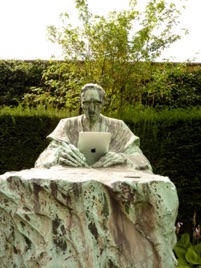
Désiré-Joseph Cardinal Mercier (1851-1926) in the garden of the KUL Institute of Philosophy
This course on Thomas Aquinas and metaphysical teachings of the Arabic Tradition focuses on the issue of Divine Knowledge and Causality, in particular with consideration of the issue of how Divine Knowledge is causative of other things and of how Divine Knowledge and Causality can be known given the limitations of human understanding.
Recommended Pre-Class Readings for Students Unfamiliar with Aristotle and Aquinas
Robert Pasnau on Language Study Recommended for Medievalists: Link
Shortcut Links 2026 Divine Knowledge and Causality
Instructors: Prof. Andrea Robiglio at KUL and Prof. Richard Taylor at MU & KUL
Marquette Location: Raynor Library 320a Thursdays 9 am – 11:40 am
First Marquette University Class: 3 September 2026; last Marquette Class 10 December
KU Leuven location: Thursday, 16h-18h30 Room MSI 2.15
First KU Leuven Class: 24 September; last KU Leuven class 17 December
Office Hours:
Prof. Robiglio: TBD CET and by appointment (particularly for Marquette students via TEAMS)
Prof. Taylor: Tuesdays & Thursdays 3:30-5 pm US Central Time at Marquette Hall 437; and by appointment in person or via TEAMS. KU Leuven students should make contact via email to arrange TEAMS appointments: Richard.Taylor@Marquette.edu or richard.taylor@hiw.kuleuven.be. Best time is Wednesday for TEAMS meetings at 17h-19h CET
Graduate Student Information Sheet : MU students: complete and email it to Prof. Taylor. NOT required of KUL students.
Course Learning Outcomes
By the end of the course, students will be able on their own to understand, interpret, and comment on Aquinas’s philosophical writing and other related texts as well as orient themselves in the technical terminology and grasp the meaning and structure of the debated issues, in some cases in the context of the Arabic philosophical tradition important to the development of the thought of Aquinas. This includes the development of these skills:
- identifying, summarizing, ‘reconstructing’ the arguments;
- engaging with sophisticated interpretations of problematic textual passages, making use of the primary and secondary sources and interpretive categories implied in them and looking for further conceptual paradigms to uncover the hidden assumptions of the reasoning;
- arguing analytically and historically for or against explanations of the debated issues as they have been presented in the literature;
- conceiving their own argumentative reflection and organizing it according to a concrete and intellectually insightful structure, expressing such in an outline and in a well-written and possibly elegant paper.
Course Grading and Work Expectations; Due Dates
The courses at Marquette University and KU Leuven are separate with distinct student trainings and distinct requirements & grading. But they come together in late September for collaborative study of the thought of Thomas Aquinas with particular focus on contextualizing his thought in relation to his sources. This approach has the descriptive name, Source Based Contextualism.
Each of these universities have distinctively different grading systems and distinctively different work expectations regarding final course papers.
Marquette students: Grades will be based on (i) Class attendance and active participation. MU students are also required to email to Prof. Taylor 24 hrs before classes one single spaced page of 2 questions based on the readings studied, unless specified otherwise. Title your email “Phil 6640 Questions: For Class [date of upcoming class]”. This will be part of the 25% participation grade ; (ii) one class team presentation 25%; and (iii) a substantial professionally prepared course paper of 18-30 pages (less bibliography) due 14 December (or earlier) 50%.T he paper must include information on whether and, if so, how AI was used in the preparation of the paper. MU students: see the guidelines at AI at Marquette.The due date is: Monday 14 December. I will entertain appeals based on good reasons for a couple of extra days, to Wednesday 16 December. After that date the options are likely a grade of F or a grade of I (incomplete), the latter if you can provide a sufficiently persuasive argument to me. Format and Style: With this paper you are practicing how to write a journal article. But the various journals often have their own required style and format. In the case of our course paper, I require you to provide an outline of the reasoning of your paper in 1-2 pages and an abstract of no more than 150 words. The paper should be written in WORD and double-spaced. Each paper must have a bibliography of sources at the end. I attach a recently published professional paper as a model for what you produce. The model, however, has neither an outline nor an abstract. But you must provide those for your papers. Model: Link.
KU Leuven students: Students should find detailed information concerning the course grading in the course ETCS-fiche or later here.
Special for Marquette students: ACCOMMODATION OF DISABILITIES: Please see me before or after your first time in class to discuss this matter. See here for Marquette’s policies: https://bulletin.marquette.edu/resources-opportunities/disability-services/.
CONSUMPTION OF FOOD AND DRINK IN CLASS: Consumption of liquids in class is encouraged as vital hydration or attention stimulation (coffee, tea, water, sodas). But consumption of food in class is prohibited except when approved by the instructor on the basis of medical need.
Religious Observances
MU Requirements for Students:
- Make every effort to schedule classes that will minimize conflicts caused by these activities and related travel.
- Provide written notification, including a schedule of all activities and related travel to all your instructors within the first two weeks of each term, or as soon as possible for non-scheduled events.
- Obtain any class notes or other course material missed due to these absences, prior to taking any subsequent examinations or submitting any subsequent graded assignments.
- Make arrangements with the instructor to make up any missed work/lectures, prior to any of these absences.
Students at KUL or MU who are unable to attend a class in person but would like to connect to the class with live video should contact Prof. Taylor at richard.taylor@kuleuven.be or richard.taylor@marquette.edu at least 30 minutes before the start of class. He will provide the link. Note that it is impossible to teach and also monitor email at the same time. Hence the 30 minutes advance contact requirement must be observed. NOTE: To access the class live or to view video recordings of classes, students must be enrolled on Microsoft TEAMS. Email Prof. Taylor with your KUL address and he will enroll you.
Some articles and other resources
Classes 3-17 September : MU only.
Classes 24 September – 3 December: MU & KUL work together
Classes later in December: KUL only.
Procedures: Student Class Presentations Starting October (TBD): Assignments for Presenters and Other Students
Student Presenter teams of ca. 3 students will be assigned to prepare presentations on texts and topics assigned by the instructors. Presentations will be made at class weekly followed by discussion and questions for an hour or a bit more. Student teams will be determined in September.
(1) Instructions for Student Presenter teams: Short Presentations
From their research on the assigned texts & other relevant sources, each topic team of presenters is to provide on the Tuesday before class a handout of no more than 6 single spaced pages with 150 word abstract and also include a 1 page outline plus a 2 page bibliography. This is to be sent to the instructors via email before 23h59 Central Europe Time for KUL students and 11:59 pm US Central Time for MU students on that Tuesday. On Thursday the student presenters team will make a summary oral presentation of 10 minutes (no more) which will be followed by comments by the instructors and then general discussion by the class. There will be 1-2 team presentations for each class 16 October – 27 November. (Note: MU students will be required to meet with Prof. Taylor to discuss their work in the days preceding their presentations.)
(2) Instructions for Other Class Students: Plan on receiving the written team presentation on Wednesday for your study. All students are expected to study at least the selected primary texts and the handout provided by the presenters. Those students not presenting in the class are expected to read carefully key selections of the texts indicated by the Instructors and to come to class with two or more written questions on the topics, the texts and / or the student team presentation.
Approximate Regular Format For Thursday Student Short Presentations: Class begins with the TEAMS connection at ca. 9 am MU / 16h00 KUL; (A) 9:10 / 16h10 (10 min) Profs Robiglio & Taylor Framing Topics; (B) 9:20-10:10 / 16h20-17h20 Presentation & Discussion; (C) 10:20-10:30/ 17h20-17h30 Break; (D) 10:30 / 17h30 – 11:10 / 18h10 Presentation & Discussion; (E) 11:10-11:30 / 18h10-18h30 Broader or Extended Discussion; then finally (F) 11:30-11:40 / 18h30-18h40 Preview for Next Class.
Advice on note taking: Do it. Note taking: See (a) https://www.npr.org/sections/health-shots/2024/05/11/1250529661/handwriting-cursive-typing-schools-learning-brain; and (b) https://www.scientificamerican.com/article/why-writing-by-hand-is-better-for-memory-and-learning/.
Students are advised to take advantage of the lectures at this webpage: Videos and Notes on the Arabic Tradition
Detailed Syllabus Schedule.
Some modifications will be made in October when we have indications of how many KULeuven students are enrolled.
Note: MU has only 7 students so their presentations will be by groups of 2, 2 & 3 students. The remaining presentations will be by KUL students.
Marquette classes before the connection with KU Leuven: setting the contexts
Class number, Date
(1) 3 Sept: (i) Introduction to the course: Final, Formal, Efficient and Material Causes; (ii) Course overview; (iii) Selected key Platonic Teachings: Republic, Timaeus, Parmenides
(2) 10 Sept: Selections of Key Aristotelian Teachings: (i) substance & accidents (Cat.), (ii) Post. An.; 1.1-4; Metaphysics: selections from books 1, 4, 6, 7, 12; (iii) Alexander of Aphrodisias
(3) 17 Sept: Selections of Key Neoplatonic Teachings: (i) Plotinus; (ii) Proclus; (iii) The Discourse on the Pure Good / Liber de causis. An available video lecture from a course taught at KU Leuven only: Link
Marquette and KU Leuven classes connect Thursday 24 Sept.
(4) 24 Sept: Linking MU & KUL (i) The Richness and Importance of the Issue of Divine Knowledge; (ii) course procedures; BREAK (iii) What is Aristotelianism in the Arabic and Latin traditions of the Middle Ages? Assigned readings for students: Prologue to Aquinas’s Commentary on the Divine Names by Dionysius; Prologue to Aquinas’s Commentary on the Liber de causis. Other assignments for MU students: Video lectures on the Plotiniana Arabica, Ibn Sina / Avicenna, Ibn Rushd / Averroes assigned to MU students for study: Link. Optional for interested KUL students. Ibn Rushd / Averrroes on Divine Knowledge Link.
(5) 1 Oct: No class with KUL. MU: Class : Instruction on writing professional papers, theses and dissertations (i) Introduction: imitating your professors: Joseph Owens, George Hourani; outlines; common structure for writing a paper: (ii) Examples: History of Philosophy Quarterly; (iii) Share published paper by Dr Tracy Wietecha and play her video on the use of outlines: Link. (iv) parameters for MU papers for this class. BEFORE CLASS read this piece about writing papers: Link; read this paper by Tracy Wietecha: Link; and read this paper published in 2025: Link. More: AAIWG 2027 Graduate Student Conference.
(6) 8 Oct: Special guest speaker, Carlos Steel, Prof. Emeritus, KU Leuven. Subject: “The famous Neoplatonic thesis that the divine cause ‘agit per ipsum esse‘ αυτῷ τῷ εἶναι, a doctrine Dionysius adopted from Proclus, which caused Thomas some difficulty because it seems to exclude divine will and freedom in creation.” Assigned readings: Link
(7) 15 Oct: Divine Knowledge (i) Ibn Sīnā / Avicenna ; (ii) Ibn Rushd / Averroes, a novel account.
Assigned readings: (1) View / study these lectures on Ibn Sina / Avicenna: Link; (2) View / study these lectures on Ibn Rushd / Averroes: Link. Recommended: Islam and creation: Link. More recommended lectures on Ibn Rushd: (1) Rationality in Theology and Philosophy of Ibn Rushd; (2) Paper Presented at Oxford and Cordoba, “A Critical Examination of Ibn Rushd on Matters of Philosophy and Religion,” with handout: Link.
Interested in the translations from Arabic to Latin? Dr Nicola Poloni, now Associate Professor of Medieval Philosophy at the University of Messina, prepared a series of five (5) lectures on that topic. His focus is largely on the work of Domingo Gundisalvi in the mid to late 12th century in Toledo. He and his team translated works by Ibn Sina / Avicenna, al-Farabi and others. He also wrote his own philosophical works. (The other great translator of that era was Gerard of Cremona.) Poloni’s 2017 lectures were prepared as a valuable part of the work of members of the Aquinas and ‘the Arabs’ International Working Group. The lectures are available via this Link.
Remarks on Sources From the Arabic Tradition in Latin Translation.
Aquinas used the following works in his Commentary on the Sentences in the first Distinction we will study, In 1 Sent, D. 36, Q.1, a.1-5, and also in later Distinctions and later works.
- The Kalām fī maḥḍ al-khair / Discourse on the Pure Good, in Latin translation by Gerard of Cremona in Toledo (ca. 1270 or so) known among the Latins as Liber de causis (LDC). For an English translation, use St. Thomas Aquinas, Commentary on the Book of Causes, trans. Vincent Guagliardo, Charles Hess, and Richard Taylor (Catholic University of America Press, 1996). This contains an English translation of the Latin as well as the Commentary of Aquinas. But keep in mind that the Commentary was completed by the mature Aquinas in 1272. The young Aquinas in writing the Commentary on the Sentences (ca.1252-55) thought the LDC was by Aristotle. Comment: Do not use the English translation by Dennis Brand published at Marquette University. It is not reliable and the translator does not understand the context and content of the LDC. There are French (1990) and German (1882)translations. The superior translation of the Latin LDC available is the 1996.
- The Metaphysics of the Shifā’ of Ibn Sīnā. Ibn Sīnā (Avicenna), al-Shifāʾ: al-Ilāhiyyāt. Ibn Sīnā (Avicenna), al-Shifāʾ: al-Ilāhiyyāt, ed. Ibrāhīm Madkūr, v.1 Books I-V, ed. Georges C. Anawati and Saʿīd Zāyid; v.2 Books VI-X, ed. Saʿīd Zāyid, Sulaymān Dunyā, and Muḥammad Yūsuf Mūsā. Cairo, 1960. Translations: The Latin in mid-late 12th century by Gundissalinus and his group is critically edited in Simone Van Riet (ed.), Avicenna Latinus: Liber de Philosophia Prima sive Scientia Divina, Leiden: Brill, in two volumes, 1977, 1980. There is a complete English in The Metaphysics of The Healing (al-Ilāhiyyāt min al-Shifāʾ), Brigham Young University Press, 2005. Note that the Latin translation is pretty decent but has many imperfections as a translation from imperfect Arabic manuscripts and is not as precise as the translation of the original Arabic as is Marmura’s English. There is a complete French translation from Arabic which is still cited by scholars but is often thought to be inferior to that of Marmura (whose translation is not perfect, of course, and is often revised or corrected by scholars quoting it in modern studies). Georges C. Anawati, O.P., La Métaphysique du Shifāʾ, Paris: Vrin 1978, 1985. There is a complete Italian translation by Olga Lizzini and Pasquale Porro, Avicenna, Metafisica, Bompiani, 2002. It includes Arabic text, Latin text and Italian translation. There is an old German translation which preceded the critical editions of the Arabic and Latin: Max J. Horten, German translation of the Metaphysics of the Shifāʾ (1907). Ibn Sīnā / Avicenna’s discussions relevant to our class topic are found in Metaphysics of the Shifā‘ Book 8, ch 6-7; Book 9.6-7. On the issue of Divine Essence, in Book 1.5 he says God has no essence; in Book 8.4-6 God has essence identical to existence. In Arabic māhiyya is quiddity: literally, mā-hiyya is translated into Latin as quidd-itas, while dhāt [self] can also be rendered as essentia, essence. There are debates by scholars concerning this issue and this vocabulary. It is from Avicenna, Metaphysics 1.2 that Aquinas picks up the notion of separate. Also from elsewhere in Avicenna Thomas accepts the notion that God is not a substance properly speaking.
- Ibn Rushd (Averroes), Long Commentary on the Metaphysics of Aristotle. This Arabic work contains a text of the Arabic of Aristotle translated from Arabic (missing Book K) and a detailed commentaryArabic: Maurice Bouyges (ed.), Averroès, Tafsīr mā baʿd al-ṭabīʿa (“Grand Commentaire de la Métaphysique”), Beirut, 1938-1952. The medieval Latin translation is available in the texts prepared at Venice, Giunta (Iuntina) edition, 1562. Dag Hasse and his collaborators at Julius-Maximilians-Universität Wurzburg are preparing a critical edition of the Latin using the Arabic and early manuscripts of the Latin translation by Michael Scot (ca. 1225 more or less). The project is ongoing. There is a valuable English translation by Charles Genequand: Averroes (Ibn Rushd). Ibn Rushd’s Metaphysics: A Translation with Introduction of Ibn Rushd’s Commentary on Aristotle’s Metaphysics, Book Lām. Translated and introduced by Charles Genequand, Leiden: E. J. Brill, 1984. (Ibn Rushd’s Arabic was missing Book K so for him Book 12 Lambda of Aristotle is Book 11.) NOTE that this translation is from the Arabic, not the Latin read by Aquinas and scholars of the Middle Ages. These latter read it both for its translation of the Arabic Aristotle and for the Commentary by Ibn Rushd / Averroes. With this and other commentaries translated in the early 13th century Averroes largely taught the Latins how to read Aristotle. For our class, we are particularly interested in Ibn Rushd, Long Commentary on the Metaphysics of Aristotle, Book Lam (11 corresponding to Aristotle 12), Text and Comment 51, for its discussion of divine knowledge. English translation of the Arabic by Genequand, Link. Latin text from Venice 1562: Link. Here is an AI machine translation of the likely Latin Aquinas read: Link.
Plotiniana Arabica: This was not known to Aquinas, though teachings in this work influenced the unknown author of the near contemporary Kalām fī maḥḍ al-khair (Liber de causis). This collection of texts was also foundational and important through the centuries in Islamic philosophical thought from the time of the translation in the early 9th CE. Ibn Sina / Avicenna studied it and wrote some commentary on The Theology of Aristotle. The three collections are (i) Theology of Aristotle, edited by al-Kindi, (ii) The Letter / Treatise on Divine Science falsely attributed to al-Farabi, and (iii)The Sayings of the Greek Wiseman. In 1959 Geoffrey Lewis’s translation was provided in Plotini Opera, ed. Henry & Schwyzer in Enneads IV-V. The Arabic was edited by Abd al-Raḥmān Badawī (ed.), Aflūṭīn ʿinda al-ʿArab: Uthūlūjiyā Arisṭūṭālīs wa-l-Nuṣūṣ al-Muntaḥala, Cairo 1955. Elvira Wakelnig edited and translated the very valuable Sayings in A Philosophy Reader from the Circle of Miskawayh, Cambridge U Press, 2014.
Summary of next weeks: Student seminars on Thomas Aquinas: (1) Commentary on the Sentences Scriptum super libros Sententiarum, Book 1, d. 35-39; (2) On Truth De Veritate Q. 2; (3) Summa theologiae, Prima pars, Q.14-16; (4) Compendium of Theology / Compendium Theologiae Book 1, ch. 28-43.
Many of the texts of Aquinas are available in Latin and English at: https://www.aquinasinstitute.org/. We are starting with the Commentary on the Sentences, book 1, which is available at https://aquinas.cc/la/en/~Sent.I . Generally, your first choice for online translations is with the Aquinas Institute. All of the texts indicated above are available on the Aquinas Institute site.
In the case of the Commentary of Thomas to the On Divine Names by (ps.)Dionysius, it seems the Latin text and English translation available at the Aquinas Institute cite are from: Thomas Aquinas, An Exposition of The Divine Names, The Book of Blessed Dionysius, translated and edited by Michael Augros, Thomas More College Press, 2021. See https://aquinas.cc/la/en/~DeDivNom.
Another source for texts and translations of Aquinas is: https://isidore.co/aquinas/.
Class Presentations: 3 for MU students, 7 for KUL students depending on enrollments.
Instructions for student presentation. The foci of our course are on the nature of divine knowledge as well as the related question of the extent to which this question can be addressed by human knowing. Student presenter groups should (i) determine the key texts on those foci, (ii) contextualize the assigned text in the work done earlier in the course, (iii) locate the key texts in their immediate context, and (iv) then proceed to explicate and raise questions on the key texts for the assignment drawing on relevant secondary literature you have discovered in your own bibliographical research. The class group presentation is a major part of student grades.
Instructions for Other Class Students: Plan on receiving the written team presentation on Wednesday for your study. All students are expected to study at least the selected primary texts and the handout provided by the presenters. Those students not presenting in the class are expected to read carefully key selections of the texts indicated by the Instructors and to come to class with two or more questions on the topics, the texts and / or the student team presentation. Note: MU students are required to submit written questions to Profs. Taylor & Robiglio on Wednesday evening.
(8) 22 Oct: Two Presentations: Scriptum super libros Sententiarum Book 1, (i) MU 1, Bret Zagar & Jordan Ruddy: Distinction 35; (ii) KUL 1: Marc Mitri, Weining You, Valentina Zhou, and Gabriel Caruana: Distinction 36.
24 October Belgium Time Change; US Time Change 1 Nov.
(9) 29 October: (i) 8 am Milwaukee / 16h Leuven: only KUL students for discussion of paper topics and parameters. (ii) 9 am Milwaukee / 17h Leuven for 90 minutes: MU & KUL together on KUL 2: Shuyuan Zhang, Renzhi Zhang, Su Wang, Lorraine Bouk, Sentences 1, D. 38; 10:30 am Milwaukee / 18h30 Leuven; (iii) 10:40-11:40 am only MU students with Prof. Taylor to discuss course paper topics.
(10) 5 Nov: MU students only: Paper topic discussion day. Each MU student should distribute to me and Prof. Robiglio (andrea.robiglio@hiw.kuleuven.be) no later than 12 Noon Tuesday 3 November an abstract of no more than 150 words and an outline of their proposed course paper. Each student will have up to 10 min. to present their ideas for the paper and to raise questions for Profs. Robiblio and Taylor.
(11) 12 Nov (i) KUL 3: Emilio Santiago Gerns Jiménez-Villarejo, Bart Van Ginhoven, Cristiana Sessini, Yuan Tian, Yavor Chokoev, Sentences 1, D. 39; (ii) MU 2, Alexandra Kilgore, Nicholas Hartman, Ethan Boord: De veritate Q. 2.
(12) 19 Nov (i) MU 3, Eugene Basonota & Peter Keepman: Summa theologiae, prima pars, Q 14, a. 1-3; KUL 4: Emre Metin, Myla White, Zhenmei Zhang, Finn Frerichs, Pietari Kaaro, Summa theologiae Q 14, a. 4-7.
(13) 26 Nov (Marquette Thanksgiving Break): KUL students only. (i) KUL 5: Sebastian, Md, Edwin, AI Vincent, Summa theologiae Q 14, a. 8-11; (ii) KUL 6: Tine, Robin, Yicheng, Ninghao, and Andrew, Summa theologiae Q 14, a. 12-16. MU students are welcome but not obliged to attend via TEAMS.
(14) 3 Dec KUL:7 : Reza, Franciszek, Fruzsina, Fatima, and Yue, Thomas Aquinas’s Commentary on (ps.)Dionysius’s On Divine Names. Precise texts TBD.
(15) Thursday 10 Dec Class Discussion: Aquinas and his Greek, Latin, Hebrew and Arabic Sources
(16) Thursday 17 Dec KUL only on short papers (i)
(17) Friday 18 Dec KuL only on short papers (ii)