Marquette University & the Katholieke Universiteit Leuven Fall 2025
Professors Andrea A. Robiglio and Richard C. Taylor
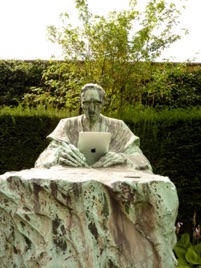
Désiré-Joseph Cardinal Mercier (1851-1926) in the garden of the KUL Institute of Philosophy
Course Description: Thomas Aquinas on Human Knowing
Recommended Pre-Class Readings for Students Unfamiliar with Aristotle and Aquinas
In this course we will study philosophical texts in Greek, Arabic and Latin with English translations made available.
A co-taught collaborative course at Marquette University (Phil 6640 Thomas Aquinas) and the Katholieke Universiteit Leuven, Belgium (Aquinas in Context)
How does intellectual knowledge of a universal sort arise from the experience of determinate particular things of sensation for Aquinas? This course will focus on the issues of belief and knowledge in the philosophical and theological thought of Thomas Aquinas (d. 1274 CE) through the careful study of relevant selections from his Opera. We will begin our study of his thought with his earliest major work (Commentary on the Sentences of Peter Lombard) in which his heavy engagement and even reliance on writings of the Greek and Arabic philosophical traditions is most evident and then focus on soundings or selections from key works in which his teachings develop, among them De Veritate, Summa contra gentiles, De Sensu, Quaestiones disputatae de anima, De Anima, De Unitate Intellectus, Commentary on the Gospel of John. Students will also be encouraged to consult his well known Summa Theologiae.
Instructors: Prof. Andrea Robiglio at KUL and Prof. Richard Taylor at MU.
Marquette Location: Raynor Library 320a Thursdays 9 am – 11:40 am
KULeuven location: Thursday, 4:00–6:30 pm, Room MSI 2.15
Office Hours:
Prof. Robiglio: Tuesday morning, from 9 am to 1 pm CET and by appointment (particularly for Marquette students via TEAMS)
Prof. Taylor: Tuesdays 8-10 and 12-1 pm US Central Time at Marquette Hall 437; and by appointment in person or via TEAMS. KU Leuven students should make contact via email to arrange TEAMS appointments: Richard.Taylor@Marquette.edu or richard.taylor@hiw.kuleuven.be.
Course Learning Outcomes
By the end of the course, students will be able on their own to understand, interpret, and comment on Aquinas’s philosophical writing, as well as orient themselves in the technical terminology and grasp the meaning and structure of the debated issues, in some cases in the context of the Arabic philosophical tradition important to the development of the thought of Aquinas. This includes the development of these skills:
- identifying, summarizing, ‘reconstructing’ the arguments;
- engaging with sophisticated interpretations of problematic textual passages, making use of the primary and secondary sources and interpretive categories implied in them and looking for further conceptual paradigms to uncover the hidden assumptions of the reasoning;
- arguing analytically and historically for or against explanations of the debated issues as they have been presented in the literature;
- conceiving their own argumentative reflection and organizing it according to a concrete and intellectually insightful structure, expressing such in an outline and in a well-written and possibly elegant paper.
Course Grading and Work Expectations; Due Dates
The courses at Marquette University and KU Leuven are separate with distinct student trainings and distinct requirements & grading. But they come together in late September for collaborative study of the thought of Thomas Aquinas with particular focus on contextualizing his thought in relation to his sources. This approach has the descriptive name, Source Based Contextualism.
Each of these universities have distinctively different grading systems and distinctively different work expectations regarding final course papers.
Marquette students: Grades will be based on (i) Class attendance and active participation. MU students are also required to email to Prof. Taylor 24 hrs before classes one single spaced page of 2 questions based on the readings studied, unless specified otherwise. Title your email “Phil 6640 Questions: [date of upcoming class]”. This will be part of the 25% participation grade ; (ii) one class team presentation 25%; and (iii) a substantial course paper of 18-30 pages (less bibliography) due 10 December (or earlier) 50%.
KU Leuven students: Students should find detailed information concerning the course grading in the course ETCS-fiche.
Special for Marquette students: ACCOMMODATION OF DISABILITIES: Please see me before or after your first time in class to discuss this matter. See here for Marquette’s policies: https://bulletin.marquette.edu/resources-opportunities/disability-services/. CONSUMPTION OF FOOD AND DRINK IN CLASS: Consumption of liquids in class is encouraged as vital hydration or attention stimulation (coffee, tea, water, sodas). But consumption of food in class is prohibited except when approved by the instructor on the basis of medical need.
Bibliographical Guide (Updating in progress)
Chronology of the Works of Thomas Aquinas
Another Chronology of the Works of Aquinas
A Chronology of the Works of Albertus Magnus
Aquinas, Commentary on the Sentences, Latin Text with English Translation
Videos and Notes on the Arabic Tradition
Students who are unable to attend a class in person but would like to connect to the class with live video should contact Prof. Taylor at richard.taylor@kuleuven.be or richard.taylor@marquette.edu at least 30 minutes before the start of class. He will provide the link.
Classes 28 August – 18 September: MU only. Introductions to Aristotle, the Aristotelian and Plotinian Traditions, the Arabic Tradition, and the Latin Tradition, including Aquinas
Classes 25 September – 4 December: MU & KUL work together
Classes 11-18 December : KUL only.
Procedures: Student Class Presentations Starting 18 October : Assignments for Presenters and Other Students
Student Presenter teams of ca. 3 students will be assigned to prepare presentations on texts and topics assigned by the instructors. Presentations will be made at class weekly followed by discussion and questions for an hour or a bit more. Student teams will be determined in September. Note this: The texts of Aquinas to be explicated in detail do not include any selections from his famous Summa Theologiae, which he prepared for students of theology. It is a very rich text. We encourage students to make some doctrinal connections where relevant to understanding the assigned texts.
(1) Instructions for Student Presenter teams: Short Presentations
From their research on the assigned texts & other relevant sources, each topic team of presenters is to provide on the Tuesday before class a handout of no more than 6 single spaced pages with 150 word abstract and also include a 1 page outline plus a 2 page bibliography. This is to be sent to the instructors via email before 23h59 Central Europe Time for KUL students and 11:59 pm US Central Time for MU students on that Tuesday. On Thursday the student presenters team will make a summary oral presentation of 10 minutes (no more) which will be followed by comments by the instructors and then general discussion by the class. There will be 1-2 team presentations for each class 16 October – 27 November. (Note: MU students will be required to meet with Prof. Taylor to discuss their work in the days preceding their presentations.)
(2) Instructions for Other Class Students: Plan on receiving the written team presentation on Wednesday for your study. All students are expected to study at least the selected primary texts and the handout provided by the presenters. Those students not presenting in the class are expected to read carefully key selections of the texts indicated by the Instructors and to come to class with two or more written questions on the topics, the texts and / or the student team presentation.
Regular Format For Thursday Student Short Presentations: Class begins with the TEAMS connection at ca. 9 am / 16h00; 9:10 (10 min) Profs Robiglio & Taylor Framing Topics; 9:20-10:10 (A) Presentation & Discussion; 10:10-10:20 Break; 10:20-11:10 (B) Presentation & Discussion; 11:10-11:30 Broader or Extended Discussion; then finally 11:30-11:40 Preview for Next Class.
Advice on note taking: Do it. Note taking: See (a) https://www.npr.org/sections/health-shots/2024/05/11/1250529661/handwriting-cursive-typing-schools-learning-brain; and (b) https://www.scientificamerican.com/article/why-writing-by-hand-is-better-for-memory-and-learning/.
In the first four weeks of the course, a general requirement is that MU students take the time to read Pasquale Porro, 2016, Thomas Aquinas: A Historical and Philosophical Profile, available online via Marqcat.
(1) 28 August MU only. Introduction to graduate study in philosophy and professional writing; Advice from a previous student now a postdoctoral researcher: Dr Traci Wietecha on writing philosophical papers and more (21 min.) Link.; studying History of Philosophy; “Source-based Contextualism;” introduction to this course and its procedures; introduction to human knowing in the Greek Tradition of Aristotle (d.322 BCE, and also his teacher, Plato d. 348/347 BCE). Aristotle: Assigned Class Readings for Today: Part 1 of 2: Physics 2.1-5 (Book 2, chapters 1-5) 192b8-197a37 = Bekker page 192b to Bekker page 197a37; 3.3, 202a12-29; Metaphysics 1.1-3; 12.1-3; Nicomachean Ethics 9.4 (note 1166a16-17), 10.7 (note 1177a26-b8); Generation of Animals 2.3, 736b27-28. Part 2 of 2: Posterior Analytics; De Anima. Link Assignment: Study the texts indicated for Part 1 of 2. In class I will do a close reading of selections of the Posterior Analytics and De Anima with you for Part 2 of 2 in class. How to access the works of Aristotle online: (i) Search Marqcat for “Loeb Classical Library Online” for Aristotle; (ii) Internet Archive; (iii) Search Marqcat for “Past Masters”.
(2) 4 September MU only. Setting the context. Part 1 of 2: Completion of the discussion of selections from Aristotle indicated for the 28 August class: see above. Part 2 of 2: analyses of key relevant teachings of Alexander of Aphrodisias (mid second century – first quarter of third century) , Plotinus (ca. 204-270 CE), Themistius (d. 387 CE). Assigned Class Readings for 4 Sept.: Link
(3) 11 Sept MU only. The Arabic Philosophical Tradition: al-Kindī (d. 873 CE), al-Fārābī (d. 950), Ibn Sīnā (Avicenna, d. 1037), Ibn Rushd (Averroes, d. 1198). Assigned Class Readings for Today Link. For next class: Read this for an overview on Aquinas and the Arabic Classical Rationalist Tradition: “The Value of the Arabic Philosophical Tradition to the Thought of Thomas Aquinas,” available via this link: Some Resources . More readings for 18 Sept forthcoming.
For those interested in the tradition of philosophy in the lands of Islam, these works are recommended: (1) Luis Xavier López-Farjeat, Classical Islamic Philosophy. A Thematic Introduction, New York & London: Routledge , 2022; (2) Routledge Companion to Islamic Philosophy, Richard C. Taylor & Luis X. López-Farjeat, eds. London & New York: Routledge, 2016; (3) The Cambridge Companion to Arabic Philosophy, Peter Adamson and Richard C. Taylor, eds. Cambridge: Cambridge University Press, 2005. All are available online via the Marquette Library.
(4) 18 Sept MU only: Part 1: More on Ibn Rushd / Averroes; Part 2: Human knowing in the 13th century Link. For more detail see https://richardctaylor.info/2025-thomas-class-today/.
(5) 25 Sept MU & KUL: Part 1: Introductions of professors and students; The major theme of the course; Course procedures; “Source Based Contextualism.” Part 2: Overview of the course content by Profs. Robiglio and Taylor. Assignments for student presentations for class (8) 16 Oct. (MU): See below.
(6) 2 October MU & KUL: Prof. Taylor on Human Knowing: Sources in the Greek and Arabic Traditions for Aquinas on knowledge and intellect. Assigned Class Readings for Today (TBA). Assignments for student presentations for (9) 23 Oct. (KUL) For more detail see above 25 September and https://richardctaylor.info/2025-thomas-class-today/.
(7) 9 Oct MU & KUL: Prof. Robiglio on Human Knowing: Christian Context and Latin Sources for Aquinas; Assigned Class Readings for Today: Link . Note: For this class all students should read this summary of the work of Marcia Colish on Peter Lombard; Assignments for student presentations for (10) 30 Oct. For more detail see https://richardctaylor.info/2025-thomas-class-today/.
(8) 16 Oct MU & KUL: Prof. Taylor at KUL. MU student presentations begin #1 Commentary on the Sentences of Peter Lombard (1a & 1b) (1a) Rev. Nicholas Hartman, Caden Page, Holly Schmid: Aquinas on the Human Soul. Main text to be explicated: (C) Whether the soul of man is corrupted at the corruption of the body aquinas.cc/la/en/~Sent.II.D19.Q1.A1; to be preceded by very brief accounts of (A) Whether the human soul is of the divine essenceaquinas.cc/la/en/~Sent.II.D17.Q1.A1 and (B) Whether the human soul is constituted of any matteraquinas.cc/la/en/~Sent.II.D17.Q1.A2. Suggested secondary literature includes two articles on soul by B. Carlos Bazán available in Some Resources.
(1b) Joseph Nguyễn, Allan Schiller, Tyler Hocket. Whether the rational soul or intellect is numerically one in all men aquinas.cc/la/en/~Sent.II.D17.Q2.A1. Suggested secondary literature includes Taylor 2013 Aquinas & the Arabs available in Some Resources.
Mondin’s very brief account of some philosophical teachings in the Commentary on the Sentences is valuable for us to see some key doctrines and topics treated in his Commentary. For Mondin, see Some Resources.. Assignments for student presentations for (11) 6 Nov. For more detail see https://richardctaylor.info/2025-thomas-class-today/.
(9) 23 Oct MU & KUL: KUL student presentations : KUL team 2: Boudaca Mae Gast, Edwin Rowan Skiglund Gold, Juliette Guillaume, Louise Hermann. (i) Thomas Aquinas, Commentary on Peter Lombard’s Sentences, Book IV, Distinction 50, Question 1, Article 1: Utrum anima aliquid intelligere possit a corpore separata– Sent.IV.D50.Q1.A1 – Aquinas. This passage addresses a crucial test case in Aquinas’s theory of human knowledge. It represents his earliest formulation (1257-58), written just before the Disputed Questions on Truth. (ii) Thomas Aquinas, Disputed Questions on Truth, Question 10: On Mind: https://aquinas.cc/la/en/~QDeVer.Q10 [List of articles: https://aquinas.cc/la/en/~QDeVer.Q10.T.] This is a rich and complex Quaestio, composed of 13 articles. You should read the entire question carefully, but for the purposes of our course and your presentation, focus especially on: Article 2: On the relationship between mind and intellect – https://aquinas.cc/la/en/~QDeVer.Q10.A2; Article 6: On the mind’s dependence on the body – https://aquinas.cc/la/en/~QDeVer.Q10.A6; Article 8: On the unity of intellect and the soul’s cognitive activity – https://aquinas.cc/la/en/~QDeVer.Q10.A8. As you’ll see, for instance, Articles 4 and 5 will help you better understand the framework for Article 6, etc. Your team handout should focus on the four articles mentioned above (Sent. IV, d. 50, q. 1, a. 1 and De veritate, q. 10, aa. 2, 6, and 8), while demonstrating a solid understanding of the entire Question 10 of De veritate as their broader context. Please make sure to coordinate among yourselves to divide the workload efficiently. We are confident your discussion will bring out some illuminating insights from these challenging but rewarding texts. Assignments for student presentations for (12) 13 Nov.
(10) 30 Oct: NOTE: REVISIONS IN PROCESS. No class with KUL today. MU class will focus on course paper topics and related matters. More Details soon.
(11) 6 Nov MU & KUL: Student presentations #4 (KUL 3) Student presentations on Summa Contra Gentiles: I, 2-8; II, 59-61 & 73-78. KUL students Alex Nemec, Vladyslav Fedorenko, Moritz Wallner, Ruofan Wang. Advice for presenters Link.) Assigned Class Readings for all students: Summa Contra Gentiles: I, 2-8; II, 59-61 & 73-78. For more detail see https://richardctaylor.info/2025-thomas-class-today/. Assignments for student presentations for (14) 27 Nov. will be assigned.
(12) 13 Nov MU & KUL Student presentations #5 (KUL 4) Thomas Aquinas’s Commentary on Aristotle’s De sensu et sensato. Anita Burato, Mauro Cioci, Lucile Goarin, Mackenzie Neufeld. De Sensu Assigned Class Readings : Aquinas’s Commentary on De sensu: Prohemium, Book I, ch. 1-4, 9, 14-18. For more detail see https://richardctaylor.info/2025-thomas-class-today/.
(13) 20 Nov MU & KUL: MU student presentations #6 (a) De Unitate Intellectus Team: Kubashev, Gardner, Hockett & #6 (b) Human knowing of God Team: Roushdy, Christon, Davies. Texts: Summa contra gentiles III, ch.51-57; I, ch. 30-37. Summa theologiae 1a q. 12, a.1; q.13; In Librum Beati Dionysius De Divinis Nominibus Expositio cap. 1, lectiones 1 & 3. (Prof. Robiglio away.) For more detail see https://richardctaylor.info/2025-thomas-class-today/.
(14) 27 Nov Thanksgiving. Required for KUL students only. Student presentations #7 (KUL 5)Amy Hawersaat, Teosphore Marshall, Maui Thuy Nguyen, Derek Wurz, Commentary on the Gospel of John. Precise assignment: Thomas Aquinas’s Commentary on the Gospel of John: Prologue, Chapter 1, lectiones 1–16, Chapter 9, lectiones 1–4. For more detail see https://richardctaylor.info/2025-thomas-class-today/.
(15) 4 December. Texts and topic: Christ’s Knowledge. Haizi Xiang, Zhang Renzhi, Zhang Jiajie, Bariscan Uyanik. Summa Theologiae, Third Part, q.9,a.1-4; q.12, a.1-4; q.15, a.8 & 10; q.21, a.1-2. For more detail see https://richardctaylor.info/2025-thomas-class-today/.
(MU final course papers due 10 December.)
(16) 11 Dec KUL short paper presentations
(17) 18 Dec KUL short paper presentations